New CDC Policy Limits the Use of Fragranced Products in All CDC Facilities Nationwide
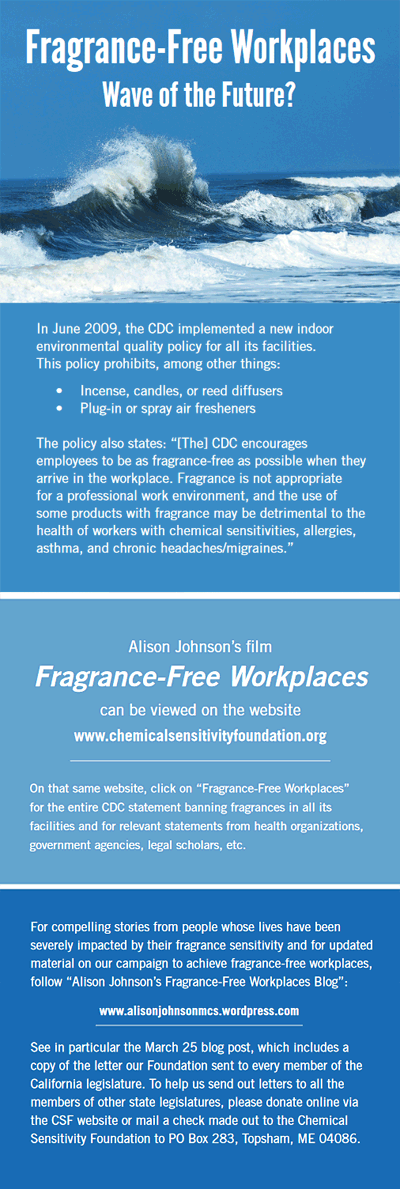
In June 2009, the CDC implemented a new indoor environmental quality policy for all its facilities. This policy prohibits, among other things:
- Incense, candles, or reed diffusers
- Plug-in or spray air fresheners
The policy also states: "[The] CDC encourages employees to be as fragrance-free as possible when they arrive in the workplace. Fragrance is not appropriate for a professional work environment, and the use of some products with fragrance may be detrimental to the health of workers with chemical sensitivities, allergies, asthma, and chronic headaches/migraines."
View the entire 13-page CDC policy.
Videos and Books by Alison Johnson, Chair of the CSF
Visitors to Johnson's website, www.alisonjohnsonmcs.com, can learn about her documentaries and read excerpts from her books.
 |
Read the Introduction to Johnson's book Amputated Lives: Coping with Chemical Sensitivity, which traces the development of multiple chemical sensitivity in Exxon Valdez clean-up workers, veterans of the 1991 Gulf War, First Responders and others exposed to the toxic aftermath of 9/11, and Katrina victims housed in toxic FEMA trailers. |
|
Read Chapter One of Amputated Lives, "The Struggle to Find a Safe Workplace." |
|
Read Chapter Two of Amputated Lives, "The Elusive Search for a Place to Live." |
|
Read Chapter Three of Amputated Lives, "The Consequences of Disbelief." |
Alison Johnson's Fragrance-Free Workplaces Blog
Recent Research from Dr. Anne Steinemann
Dr. Anne Steinemann, a civil engineer with a PhD from Stanford who has taught at Georgia Tech and the University of Washington and now holds a chair at the University of Melbourne, has published extensive research on toxic chemicals in fragranced products and has also published several studies on the prevalence of fragrance sensitivity and of multiple chemical sensitivity. For more information, visit her website:
Read more about Dr. Steinemann's research
HUD Considers Multiple Chemical Sensitivity to Be a Disability
Another goal of the Foundation is to call attention
to the housing problems faced by those with multiple chemical sensitivity.
There is a great need for housing that is constructed, remodeled,
or furnished in such a way as to minimize the use of building materials
and furnishings that contain and release formaldehyde and other
toxic chemicals that can cause severe problems for the chemically
sensitive. We also believe that it is important to educate landlords
about the effects that their pest-control or cleaning chemicals
can have on the chemically sensitive. In 2004 the Foundation provided
seed money to produce a DVD to raise awareness about chemical sensitivity
among landlords serving renters receiving funds from programs of
the U.S. Department of Housing and Urban Development (HUD). This
DVD contains an introduction from Bennie Howard, then Acting Deputy
Director for the Office of Disabilities at HUD, in which he stated
that HUD considers multiple chemical sensitivity to be a disability
under the Fair Housing Act and the Americans with Disabilities Act.
Click
here to read Bennie Howard's complete statement.
Guide to the HUD Section 8 Housing Choice Voucher Program for Persons Disabled with Multiple Chemical Sensitivity
This important new 21-page booklet full of useful information will help chemically sensitive people better understand and navigate the bureaucratic intricacies of this program that can assist them to obtain accessible affordable housing. Author R. S. Hurley states in her Introduction: “Do not simply take ‘no’ for an answer. Instead, use the HUD regulations and Public and Indian Housing (PIH) notices in this booklet to help you get what you need.” She provides detailed information about whom to contact at HUD and how to frame your requests in the most effective way, and she also includes sample letters. Click here for further information.
NIEHS Seminar: "Multiple Chemical Sensitivity"
A major milestone in the Chemical Sensitivity Foundation’s efforts to raise awareness about chemical sensitivity occurred in October 2010, when Chair Alison Johnson was invited to present a seminar titled “Multiple Chemical Sensitivity: A Rapidly Growing Disorder” at the National Institute of Environmental Health Sciences (NIEHS), a branch of the NIH. This event was cosponsored by the NIEHS National Toxicology Program and the NIEHS Disability Advocacy Committee.
Click here for the article about the seminar appearing in the December issue of the NIEHS newsletter.
Chemical Sensitivity Bibliography
Our efforts to raise awareness about chemical
sensitivity include the distribution of a twelve-page selected bibliography
of studies and articles on chemical sensitivity published in peer-reviewed
journals. The amount of solid research on this subject is expanding
each year, and we believe it is important to alert physicians and
researchers to scientific information on this condition that is
as yet not always recognized or understood. One of our goals in
distributing this list is to stimulate other scientists to consider
launching research studies in this field.
Click
here for the Selected Bibliography of Research Articles.
|
| |
|
|
| |
Help change the world one card at a time.
Click here for more information about obtaining these 4" x 6" cards to hand out to friends, relatives, businesses, etc. The cards provide relevant websites on the reverse side.
Unfortunately, the Chemical Sensitivity Foundation has no money available to help individuals with workplace issues, housing, or legal problems. We do not have a salaried staff to answer your questions and suggest that you read the articles reached by the links on the left of this page. Of particular importance are “Searching for an Elusive Cure,” “Heating Systems and Gas Stoves,” and “Air Quality Testing.” |
This is the first section of a booklet published by Ann McCampbell, M.D.
Read more
This is the first section of Chapter Four in Multiple Chemical Sensitivity: A Survival Guide by Pamela Reed Gibson, Ph.D.
Read more
|
|
|